Start with the equipment that must stay powered, then match its watts, starting current, phase, waveform and required runtime to the inverter architecture. By the end, you will have a practical specification checklist for comparing quotations, battery designs and installation support without relying on a kVA label alone.
Key takeaways
- Choose online UPS topology for sensitive, uninterrupted business equipment.
- Match inverter VA, kW, phase and surge ratings to measured loads.
- Calculate backup time from usable battery energy, not battery nameplate capacity.
- Demand battery specifications, installation records and post-sale response terms in writing.
Which inverter topology and phase configuration fit your business load?
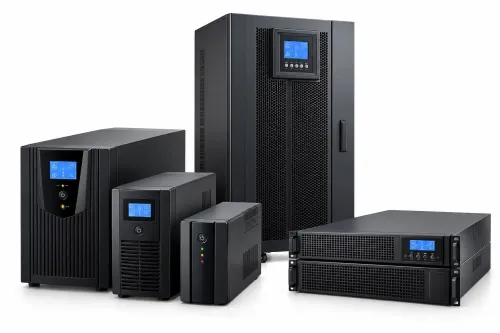
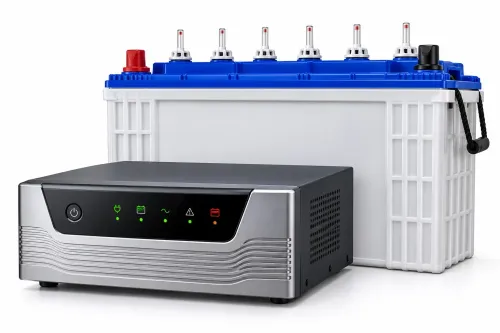
A basic inverter suits non-critical lights, fans and retail equipment; an inverter-charger adds battery charging and generator or grid coordination. A line-interactive UPS regulates moderate voltage variation but transfers the load during a utility failure.
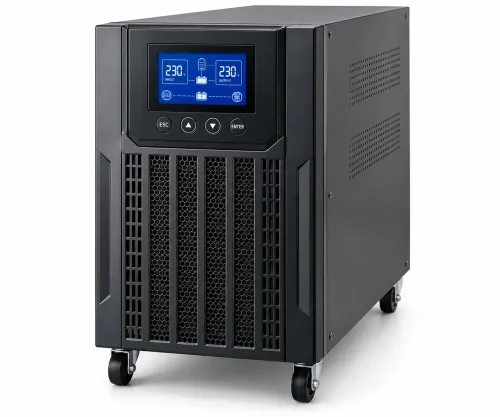
An online double-conversion UPS continuously rebuilds the output, so it avoids that transfer break and normally carries the IEC 62040-3 VFI classification.
| Option | What it does | Suitable load |
|---|---|---|
| Basic inverter | Converts DC battery power to AC with limited regulation | Lights, fans and non-critical office or retail equipment |
| Inverter-charger | Converts AC and charges batteries, with selectable charging and bypass functions | Offices, shops and sites using generators or frequent outages |
| Line-interactive UPS | Uses an AVR and transfers to inverter during failure | Network devices, point-of-sale systems and less transfer-sensitive equipment |
| Online double-conversion UPS | Converts AC to DC, then continuously regenerates AC | Servers, storage, medical devices and sensitive industrial controls |
Match the phase configuration to the equipment, not only the incoming service. Use a single-phase UPS for single-phase loads; choose a three-phase input/output model for a three-phase motor, plant panel or balanced server room. A three-phase supply feeding single-phase equipment needs phase-load balancing and a defined bypass arrangement.
Ask for the exact transfer time, bypass-transfer conditions, output regulation and manufacturer declarations or test data to IEC 62040-1, IEC 62040-2 and IEC 62040-3. This power inverter buying guide rule prevents a “UPS” label from hiding an unsuitable topology.
Which electrical specifications prove that the inverter can run your equipment?
A 10 kVA inverter can still fail a 7 kW load if its real-power limit, power factor, surge capacity or waveform is unsuitable. Compare the complete power inverter specifications in Nagpur, not VA alone.
| Specification | What to compare | Why it matters |
|---|---|---|
| Rated capacity | Continuous kVA and watts, output power factor, and surge rating | A unit rated 10 kVA at 0.8 power factor delivers only 8 kW. Motor, compressor and printer startup can exceed running demand. |
| Waveform and distortion | Pure sine wave, voltage THD and current THD at nonlinear loads | Servers, LED drivers, variable-speed drives and switch-mode supplies can overheat, trip or become unstable with distorted output. |
| Voltage and frequency | Nominal output voltage and 50 Hz frequency; steady-state voltage regulation and frequency regulation | Check compatibility with your equipment and specify response to step loads, not just the nominal figures. |
| Load behaviour | Crest-factor capability and unbalanced-load tolerance | High-crest-factor rectifiers draw sharp current peaks; uneven three-phase loading can overload one phase first. |
| Overload and faults | Percentage and duration, battery-mode overload, short-circuit clearing, bypass rating and transfer time | Startup current can trip an undersized inverter even when continuous kVA looks sufficient. |
| Efficiency | Efficiency at 25%, 50%, 75% and 100% load, including online double-conversion operation | A poor light-load figure wastes electricity and reduces battery runtime. |
For an online UPS, look for IEC 62040-3 VFI classification. Ask for test results using your actual load mix, not only a linear resistive load.
How do you calculate power inverter capacity and backup from the actual load?
A realistic power inverter capacity and backup calculation starts with measured running watts, not the appliance labels alone. Add the worst simultaneous starting surge from motors, compressors or pumps, then include planned expansion.
Select an inverter whose rated kW covers continuous real power and whose overload rating handles the peak; do not rely only on kVA.
- Record each load’s running watts and power factor, then total the real power in kW.
- Identify which motors, compressors or transformers start together and record their peak watts or starting current.
- Add an expansion allowance to the measured running load before selecting capacity.
- Check both ratings: kW equals kVA multiplied by power factor. A 100 kVA inverter at 0.8 power factor supplies 80 kW, not 100 kW.
For backup, use nominal battery energy in kWh = load kW × required hours ÷ (inverter efficiency × usable battery fraction). A 10 kW load for 30 minutes at 90% efficiency and 80% usable discharge needs about 6.94 kWh of nominal battery energy, before ageing, temperature, cable losses and manufacturer limits.
The quick runtime estimate is battery voltage × ampere-hours × usable fraction × efficiency ÷ load watts. Treat it as a screening calculation. A battery’s Ah rating is meaningless without its discharge duration, end voltage, temperature and age; request the manufacturer’s discharge table for the target runtime.
Require the supplier to state end-of-life autonomy, not only new-battery runtime.
How should you verify batteries, ambient conditions and incomplete catalogue claims?
A runtime claim without battery conditions is incomplete; require the load, battery chemistry, bank voltage, ampere-hours, discharge end voltage, efficiency, usable discharge fraction and battery age used for the calculation.
1. Request the autonomy table at your actual critical load, not a headline figure. It must state whether the result assumes new lead-acid or lithium batteries, the discharge rate, end voltage, recharge time, ageing allowance and minimum end-of-life runtime. Ask for the battery-sizing report and record the test method and pass/fail limit.
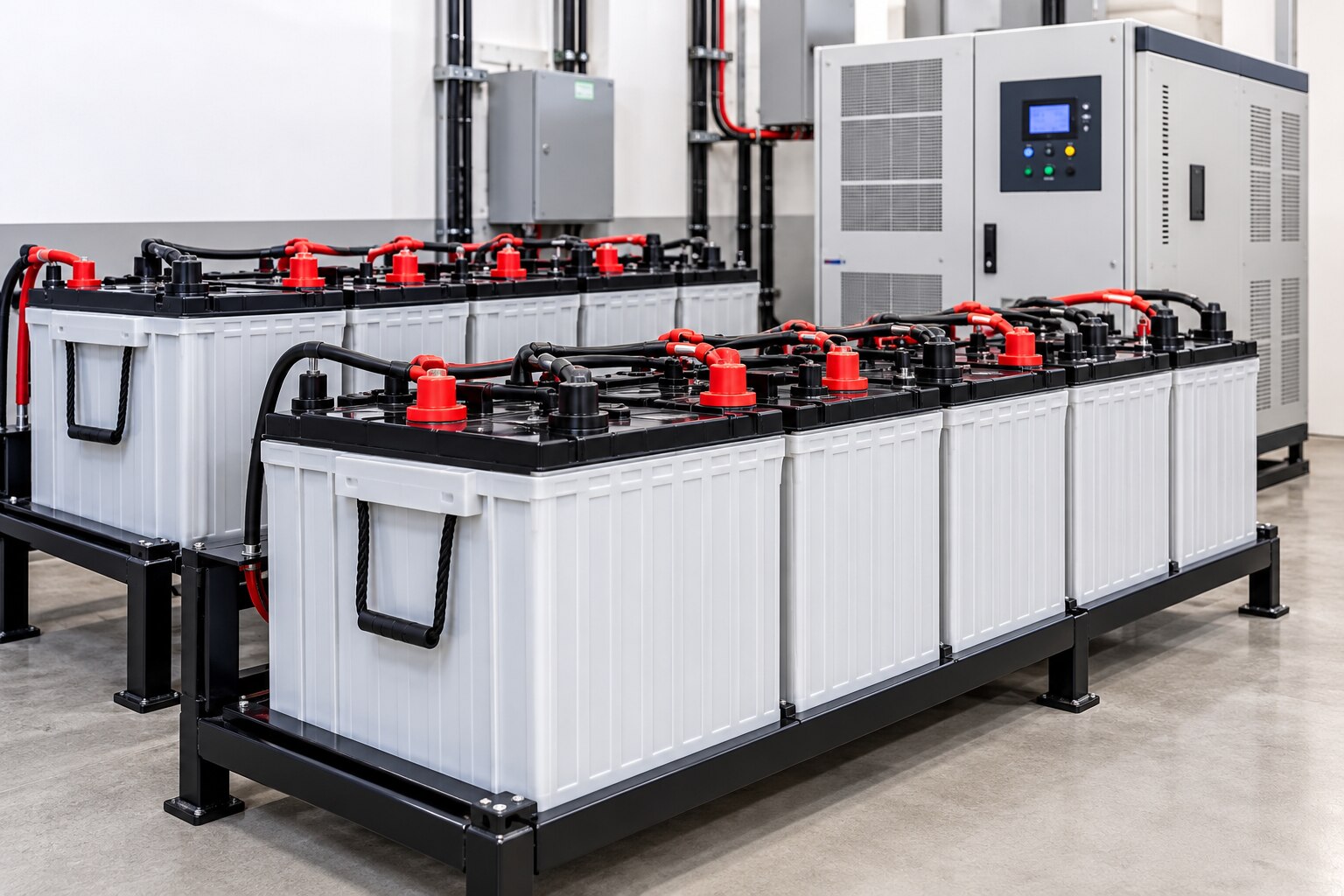
2. Match the output-derating curve to the site’s hottest room temperature, not only the nominal 25°C rating. Specify air-conditioning or forced ventilation, battery-room layout, temperature alarms, fire separation and access clearance; heat reduces UPS output and accelerates lead-acid ageing.
3. Obtain the installation drawing and single-line diagram for power inverter details in Nagpur. Confirm the battery fuse, DC and AC isolators, input and output breakers, surge protection, neutral arrangement, protective earthing, cable voltage drop and external clearances. Require the supplier to mark which protections are internal and which you must install.
Reject a catalogue that says “capacity” or “backup” without these conditions. Also request the product datasheet, protection settings, alarm list, battery warranty, maintenance schedule and commissioning report. A runtime test at the connected load exposes optimistic calculations before the equipment becomes critical.
What should a business power inverter supplier in Nagpur deliver after the sale?
A business power inverter supplier in Nagpur should deliver documented engineering, supervised commissioning, recorded test results and a defined service plan—not merely a kVA quotation and a warranty card. A local address does not prove capability for your battery voltage, bypass architecture or connected load.
- Review your single-line diagram and load schedule, then issue a battery-sizing report using discharge rate, end voltage, temperature and the requested autonomy.
- Provide installation drawings showing AC and DC isolators, breakers, battery fuses, surge protection, neutral arrangement, protective earthing, cable voltage drop, ventilation, fire separation and access clearance.
- State which protections are internal to the inverter and which require external installation. Assuming the cabinet contains all site protection creates dangerous gaps.
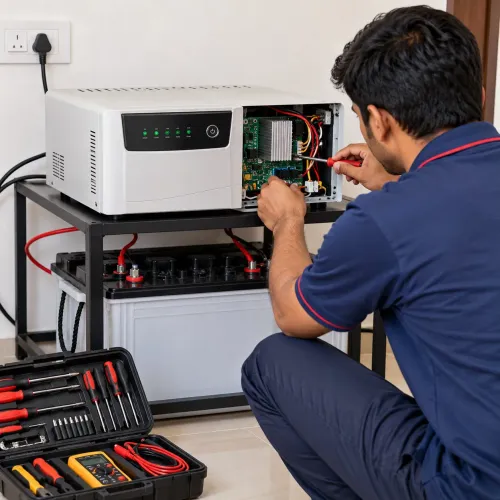
- Commission the system with recorded input and output voltage, frequency, polarity, phase sequence, alarms, bypass operation and protection settings.
- Perform a load-bank or autonomy test against the agreed load, battery voltage and end-of-discharge limit; do not accept a runtime claim based only on nominal ampere-hours.
- Hand over alarm meanings, operating procedures, as-built drawings, warranty contacts and a preventive-maintenance schedule.
- Put spare-parts availability, response-time SLA and replacement-battery logistics in writing.
Mahendra power Zone becomes easier to assess when you request these documents before comparing its quotation with another supplier’s. The lowest price is poor value if failed batteries, unclear protection or delayed service stop operations.
Related products
 | Power Inverter Ecovolt 1050 Luminous Inverter Product Details: Phase Single Output Frequency 50 Hz Weight 10-25kg Model Ecovolt 1050 Warranty 1 Year Brand Luminous... View product → |
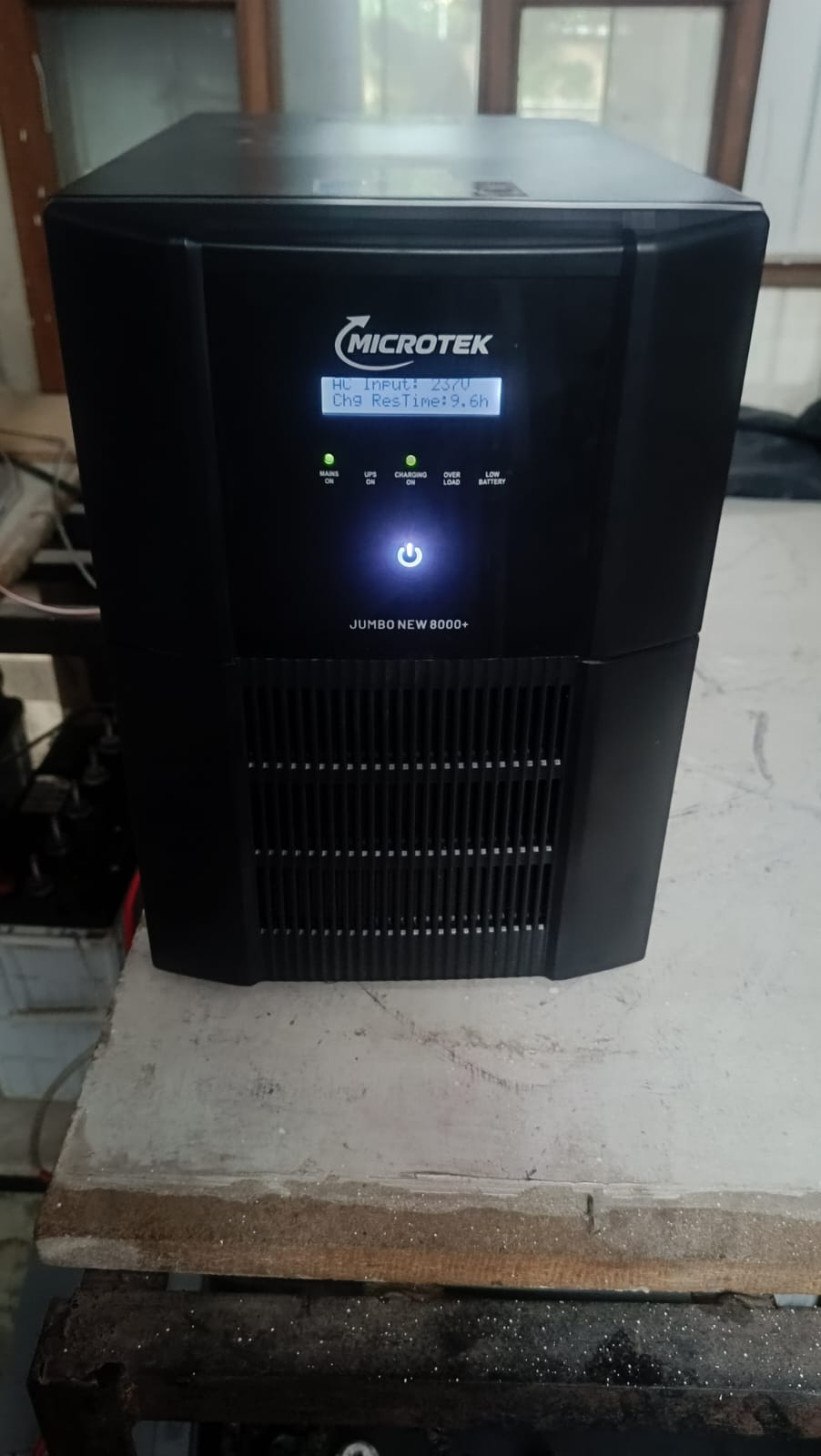 | Inverter inverter View product → |
Frequently asked questions
Which inverter topology and phase configuration fit a business load?
Use an online double-conversion UPS for sensitive equipment and zero-transfer protection. Choose single-phase or three-phase input and output to match the utility supply, distribution board and connected load.
Which electrical specifications prove an inverter can run business equipment?
Check rated VA and kW, output voltage, frequency, waveform, transfer time, overload duration, short-circuit rating, input voltage range, power factor and crest-factor capacity.
How do you calculate power inverter capacity and backup time?
Measure the connected and running load, add motor or compressor starting demand, then select capacity with operating headroom. Estimate backup from battery voltage multiplied by ampere-hours, adjusted for inverter efficiency and usable depth of discharge.
What battery and ambient-condition details should you verify?
Confirm battery chemistry, voltage, ampere-hour rating, quantity, design life, charging current, warranty conditions and replacement process. Check the inverter’s operating temperature, humidity, ventilation and derating limits.
What should a business power inverter supplier in Nagpur deliver after the sale?
Require a load survey, single-line diagram, battery schedule, installation report, commissioning test, warranty documents, preventive-maintenance plan, emergency contact and written response times.
Related products
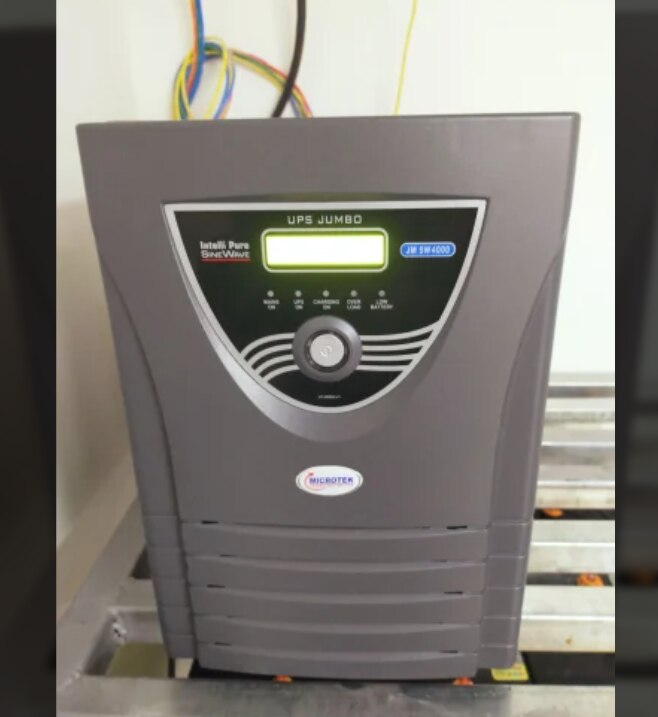 | Ups System Type Inverter UPS Brand Eaton Model Name/Number Microtek Online Ups Usage/Application Industrial Battery Type Microtek Online Ups Phase Microtek... View product → |
 | Inverter Battery Brand Exide Product Type Inverter Battery Color Red Use Electricity Backup Load Crest Factor 31 Country of Origin Made in India We MAHENDRA POWER... View product → |
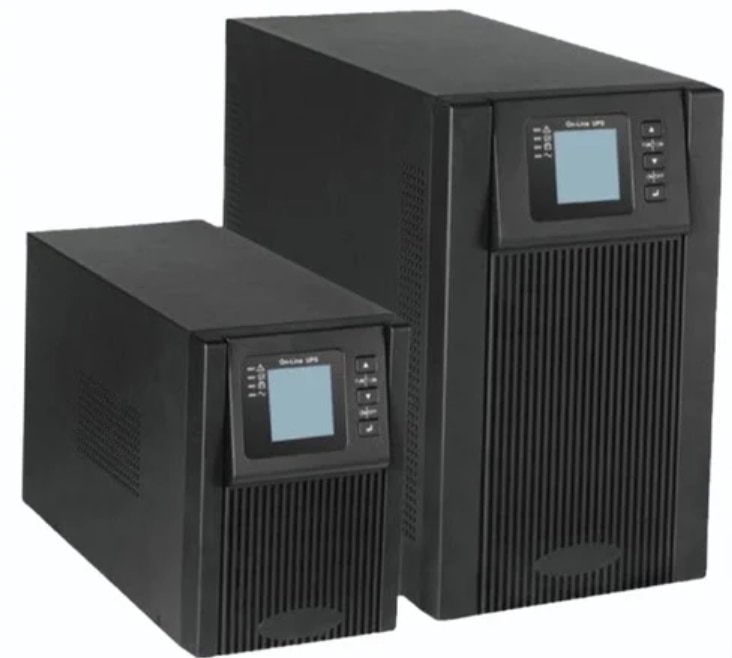 | Online Ups Capacity 5 KVA Configuration 3 Phase IN & 3 Phase OUT Model Name/Number 5 KVA ONLINE UPS Back Up Time 30 Mins Battery Backup 90 Number Of Batteries... View product → |
 | Ups Battery Type Online Brand Eaton Usage/Application Industrial Protection OverVoltage Warranty 1 Year We MAHENDRA POWER POWER , leading supllier of UPS... View product → |
Keywords