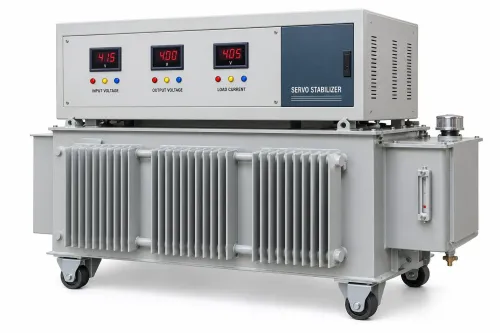
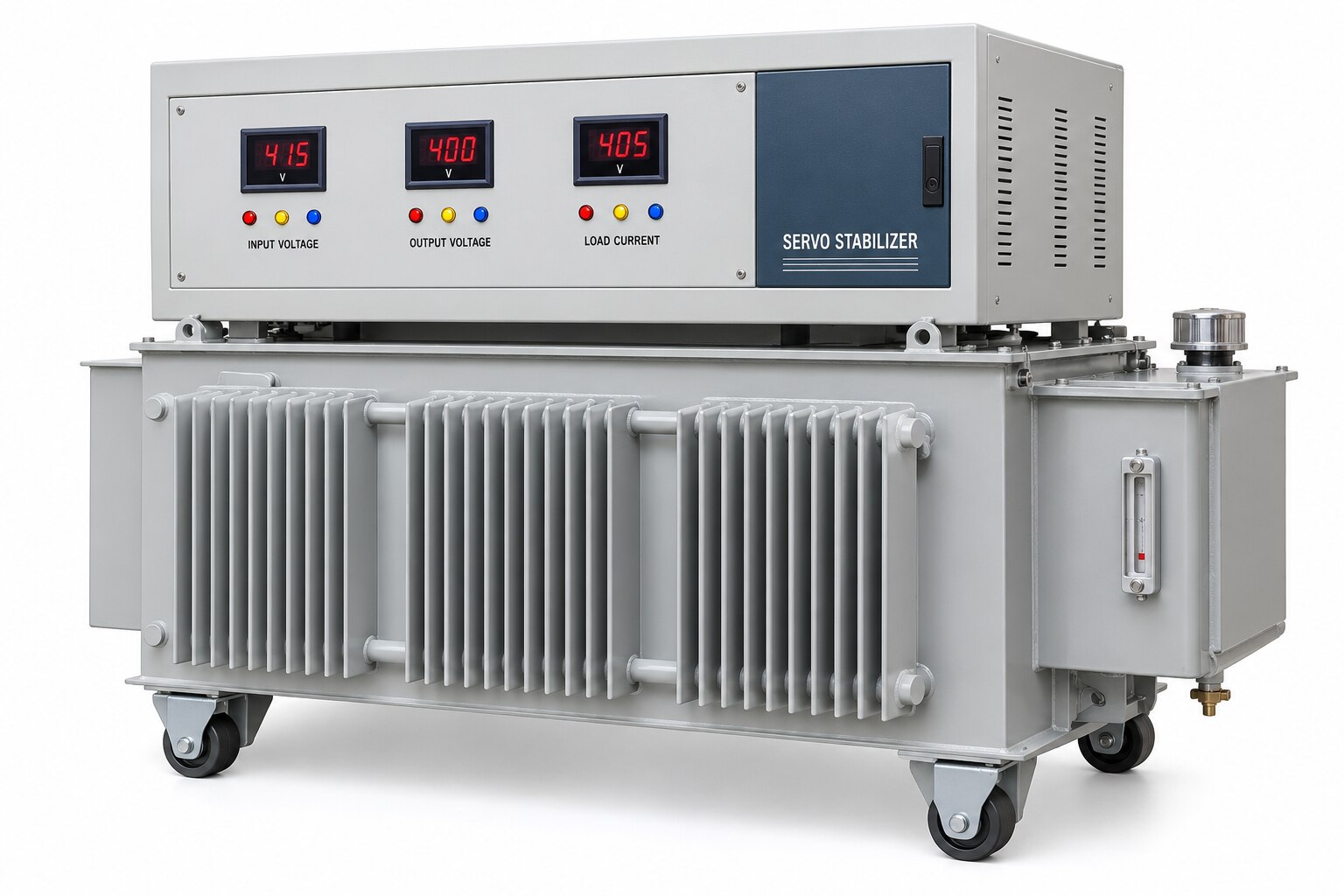
Switch off the connected load before you reset, open, or bypass a failed servo stabilizer. You will learn how to separate a supply problem from a stabilizer fault, collect safe measurements, brief a technician, and decide whether repair, replacement, or another power solution is appropriate.
Key takeaways
- Switch off connected equipment and isolate the stabilizer at its input MCB or MCCB.
- Compare stabilizer input, output, bypass, and alarm readings before arranging service.
- Give the technician ratings, fault codes, recent events, and clear photos of the unit.
- Replace instead of repairing when key components are obsolete, repeatedly failing, or undersized.
What to do in the first five minutes
Switch off the connected load immediately, then isolate the servo stabilizer at its input MCB or MCCB. Do not open the cabinet or touch terminals while energized. This prevents a failed control circuit, shorted power device, or abnormal output from damaging computers, motors, and other equipment.
Use this five-minute servo stabilizer troubleshooting checklist:
- Check the upstream distribution board. A tripped breaker, blown fuse, phase loss, or complete mains failure points to the supply, not the stabilizer.
- Read the panel indicators before resetting anything. Record input voltage, output voltage, current, alarm code, trip indication, and whether the display shows bypass.
- Look for loose or burnt cable lugs, smell of overheating, damaged insulation, or a fan that has stopped. Do not re-energize after finding burn marks.
- If a qualified electrician is present, measure voltage at the distribution board and at the stabilizer input terminals while the load starts. A large drop between those points indicates a cable, breaker, lug, or connection problem.
- For a three-phase unit, check every phase voltage and current. A normal displayed average can hide one failed sensing circuit or motor-control channel.
Use bypass only after confirming that incoming voltage is within the equipment’s permitted range and the transfer is approved by a qualified person. Never bypass a unit producing abnormal voltage. Record whether the fault occurs at idle or only during startup, then give these readings and observations to the technician.
How to tell a supply fault from a stabilizer fault
Compare voltage at the upstream distribution board with voltage at the stabilizer input terminals while the load starts. If the board voltage is steady but the stabilizer terminals drop sharply, suspect the breaker, cable, lug, loose terminal, or connection impedance—not the regulation circuit.
1. Confirm the mains condition with a properly rated meter. Record phase-to-phase or phase-to-neutral voltage, frequency, and all three phases. A missing phase, phase reversal, or severe imbalance points to the supply or incoming wiring.
2. Check the MCB or MCCB, control fuse, overload relay, and emergency-stop circuit. A tripped breaker or blown fuse identifies a protection fault; do not replace a fuse with a higher-rated type.
3. Compare stabilizer input and output under operating current, not only at no load. A no-load reading can hide a failing contactor, undersized cable, loose terminal, or carbon brush.
4. For a three-phase unit, record each output phase voltage and load current. One sensing or motor-control failure can leave the displayed average looking normal while one phase is unsafe.
5. If input voltage is correct, protection devices are healthy, and output remains absent or abnormal, isolate the unit and request servo stabilizer troubleshooting. Do not use bypass while the stabilizer produces abnormal voltage; bypass removes correction and can expose equipment to damaging supply conditions.
Give the recorded readings, alarms, fault code, and automatic or bypass status to a servo stabilizer repair service. Include the result of any phase or cable checks.
What to give a technician before arranging a site visit
A technician can avoid an inspection-only visit if you send the nameplate photo, recent fault details, and measurements taken while the load is operating. State the make, kVA rating, serial number, single- or three-phase arrangement, input and output voltage, load type, and whether the failure occurs only when motors or compressors start.
1. Record phase-to-phase or phase-to-neutral input voltage, output voltage, frequency, and load current on every phase. Note the alarm or fault code, automatic or bypass mode, and whether an MCB, MCCB, or control fuse has tripped.
2. Describe the exact symptom: no output, high or low output, hunting voltage, contactor noise, burning smell, overheating, or a trip after a delay. Do not keep resetting the unit if output stays abnormally high or low; report that condition so the technician checks the limit switches and feedback potentiometer.
3. Confirm whether bypass is available, whether the load can be shut down for testing, and whether the fault appeared after rewiring, a power cut, lightning, or equipment installation. Send clear photos of the control panel, terminals, cable entries, ventilation, and surrounding space.
4. Provide safe access details, working hours, lifting restrictions, and whether the unit is dusty, damp, hot, or poorly ventilated. Keep the connected load available for a controlled test, but do not open live equipment.
For servo stabilizer repair in Nagpur, Mahendra power Zone can use this record to carry likely brushes, fuses, contactors, motors, or control-board parts. For servo stabilizer service in Nagpur, include the last maintenance date and any previous repair report.
Related products
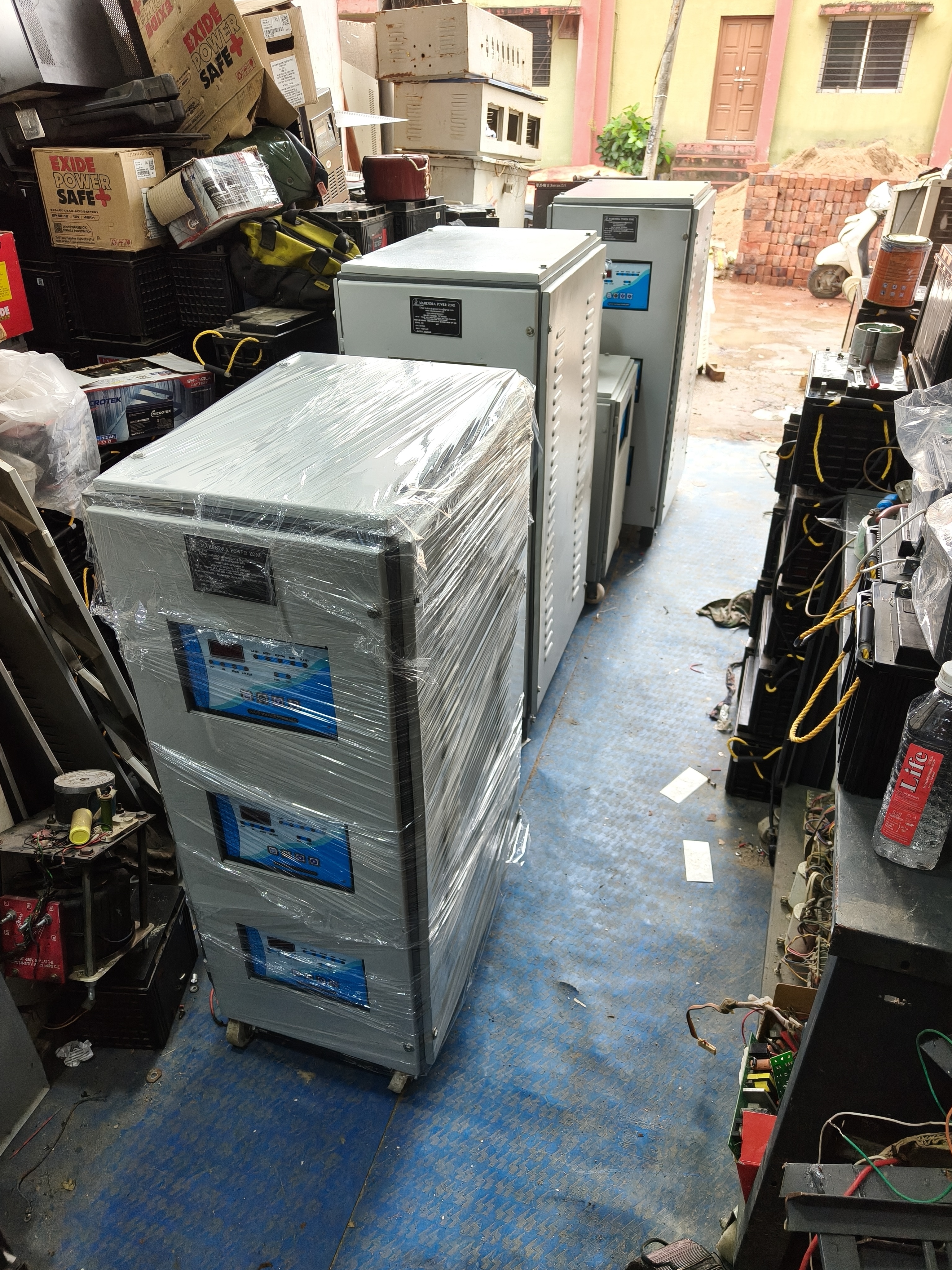 | Three Phase Servo Voltage Stabilizer industrial SERVO voltage stabilizer View product → |
 | Servo Stabilizer Capacity (Kva) 2 KVA Phase Single Phase Input Voltage 170 to 270 V Body Material Steel Type Automatic Frequency (Hz) 50 - 60 Hz Matching up with the... View product → |
When repair is sensible—and when another power solution is better
Repair is sensible when the stabilizer’s kVA, phase configuration and correction range suit the load, and the fault is limited to a replaceable part. Replace it when the transformer, variac, power contacts or enclosure is badly damaged, or when repeated repairs cost more than a dependable new unit.
| Option | Choose it when | Reject it when |
|---|---|---|
| Repair | A worn carbon brush, dirty variac track, sensing circuit, fuse, contactor or motor/gearbox causes the fault | The unit is undersized or has recurring insulation, winding or mechanical damage |
| Replace servo stabilizer | The load has grown, the unit is obsolete, or repair history is frequent | The real problem is generator frequency or waveform quality |
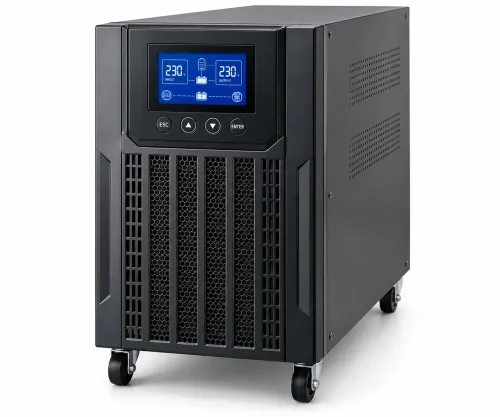
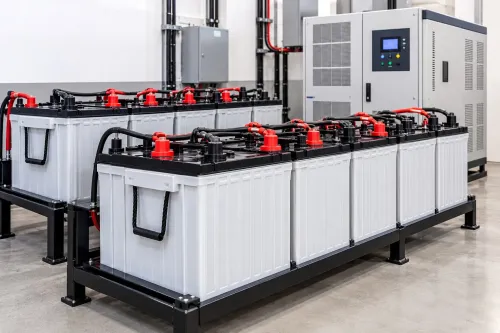
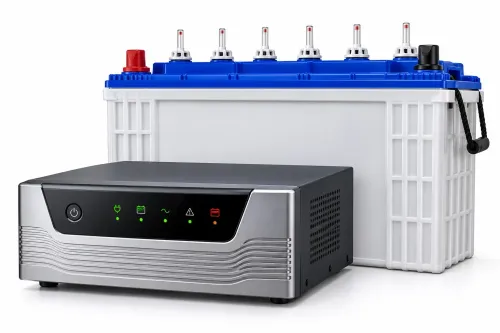
| UPS | Equipment must continue running through outages and voltage dips | You need long backup for large motors without sizing batteries and inverters correctly |
| Generator | Outages last beyond practical battery runtime | You need clean frequency, fast transfer or silent operation without additional controls |
| Static stabilizer or AVR | Fast voltage correction suits electronic loads with modest inrush | Motors, compressors or transformers demand high starting current |
| Transformer-based solution | Isolation, voltage conversion or a fixed voltage ratio is the actual need | The fault is variable mains voltage requiring active correction |
Repeated motor stalling is a sizing problem, not an output-set-point problem. Check running kVA, power factor, starting current and neutral loading before choosing equipment; large rectifier-input UPS systems also need inrush capacity.
A servo stabilizer repair service should test low, nominal and high input, intended phase current, output accuracy, correction direction, cutoffs and bypass transfer. For three-phase units, record every phase voltage and current. Test generator frequency and waveform separately: a stabilizer does not correct either.
What proper service and preventive maintenance should include
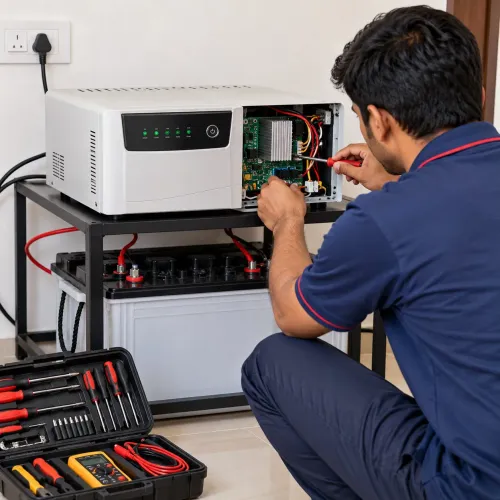
A proper visit ends with measured proof, not a fuse replacement or a reset. The technician should isolate the unit, inspect terminals and protection devices, and record input and output readings before opening the enclosure.
Measure voltage at the stabilizer input terminals during load starting and compare it with the upstream distribution board; a large difference points to cable, breaker, lug, or connection impedance.
- Clean the variac track, brush holder, fan filters, cooling paths, and control-panel ventilation. Remove conductive dust without blowing it into the control electronics.
- Check brush pressure, brush length, tracking marks, motor movement, contactor operation, terminal tightness, earth continuity, insulation condition, and heat damage.
- Run the repaired stabilizer at low, nominal, and high input voltage. Test the intended load current, output accuracy, correction direction, high- and low-voltage cutoffs, and bypass transfer without interrupting or dangerously exposing the load.
- On a three-phase model, capture each phase’s input and output voltage and current. A normal average display can hide one failed sensing channel and serious phase imbalance.
- Record the make, model, kVA, serial number, voltage limits, alarms, cutoff results, brush and variac condition, fan and filter condition, measurements, and next inspection date.
Good stabilizer maintenance in nagpur addresses dust, heat, monsoon moisture, and unstable supply. Keep vents clear, replace clogged filters, tighten connections during scheduled inspections, and keep the enclosure dry. For servo stabilizer service in nagpur, request a load-start test; it exposes voltage sag that a no-load test misses.
Frequently asked questions
What should you do in the first five minutes after a servo stabilizer stops working?
Switch off the connected load, isolate the stabilizer at its input MCB or MCCB, and do not open the energized cabinet or touch terminals.
How can you tell whether the supply or the stabilizer has failed?
Check the upstream MCB, incoming phase voltage, stabilizer input and output readings, bypass status, alarms, and whether other circuits have power. A qualified technician should perform live electrical tests.
What information should you give a technician before a site visit?
Provide the stabilizer rating, phase configuration, make and model, fault code, input and output readings, recent overloads or outages, maintenance history, and photos of the display and cabinet.
When is servo stabilizer repair sensible?
Repair makes sense when the cabinet, transformer, motor, control board, and protection devices remain serviceable and the repair cost is justified by the unit's age and reliability.
What should servo stabilizer service and preventive maintenance include?
Service should include safe isolation, terminal and cable inspection, cleaning, ventilation checks, input and output measurements, alarm testing, carbon-brush and variac inspection, and verification under load.
Keywords